Travel Theme: Rhythm

The WheresMyBackpack? Travel Theme Challenge this week is Rhythm.

Capturing a sense of sound and rhythm in photos is an interesting challenge. From our travels in the past few years, here are my rhythmic memories:

1) The drone of the piper playing at the base of Glencoe (the Valley of Tears) in the Scottish Highlands. The Glen’s “tears” are springs of water forming tiny waterfalls. However, the name took on a second meaning when, in 1692, a group from Clan Campbell sympathetic to the English king slaughtered the MacDonalds of Glencoe in the valley. Having sought the hospitality of the MacDonalds on a winter’s night, the Campbells killed them as they slept. Some MacDonalds escaped up the sides of the mountain, many freezing to death. The piper plays in memory of those lost in the “Glencoe Massacre.”

2) The huge drums beating at the closing ceremonies for the Beijing Olympic Games – there was a drummer strapped to each side of these drums, which were raised to the top of the stadium, beating all the way.

3) The swing and rhythm of the hula dancers at a Luau on Oahu, echoing the rhythm of the nearby surf on the sand.

For other responses to this challenge, click here!

Posted in Photo Challenges | Tagged , , , , , , , , , , , , , | 24 Comments

Weekly Photo Challenge: Today

The WordPress Weekly Photo Challenge for this week is Today, meaning that the photos couldn’t be from an archive – they actually had to be taken on the day of the post.

So… today was the last sunny day in our local forecast for about week. Taking that into account, I figured this would be the day to take an outdoor walk.  I chose the town green in our “downtown” area. I can’t speak for all states, but every town of any size in New England and Upstate New York has a town green, and on that green, most have a Civil War memorial.  In our town, the post office is at one end of the green, and the memorial is at the other. So, after checking my Post Office Box, I decided to walk the green to the memorial and back.

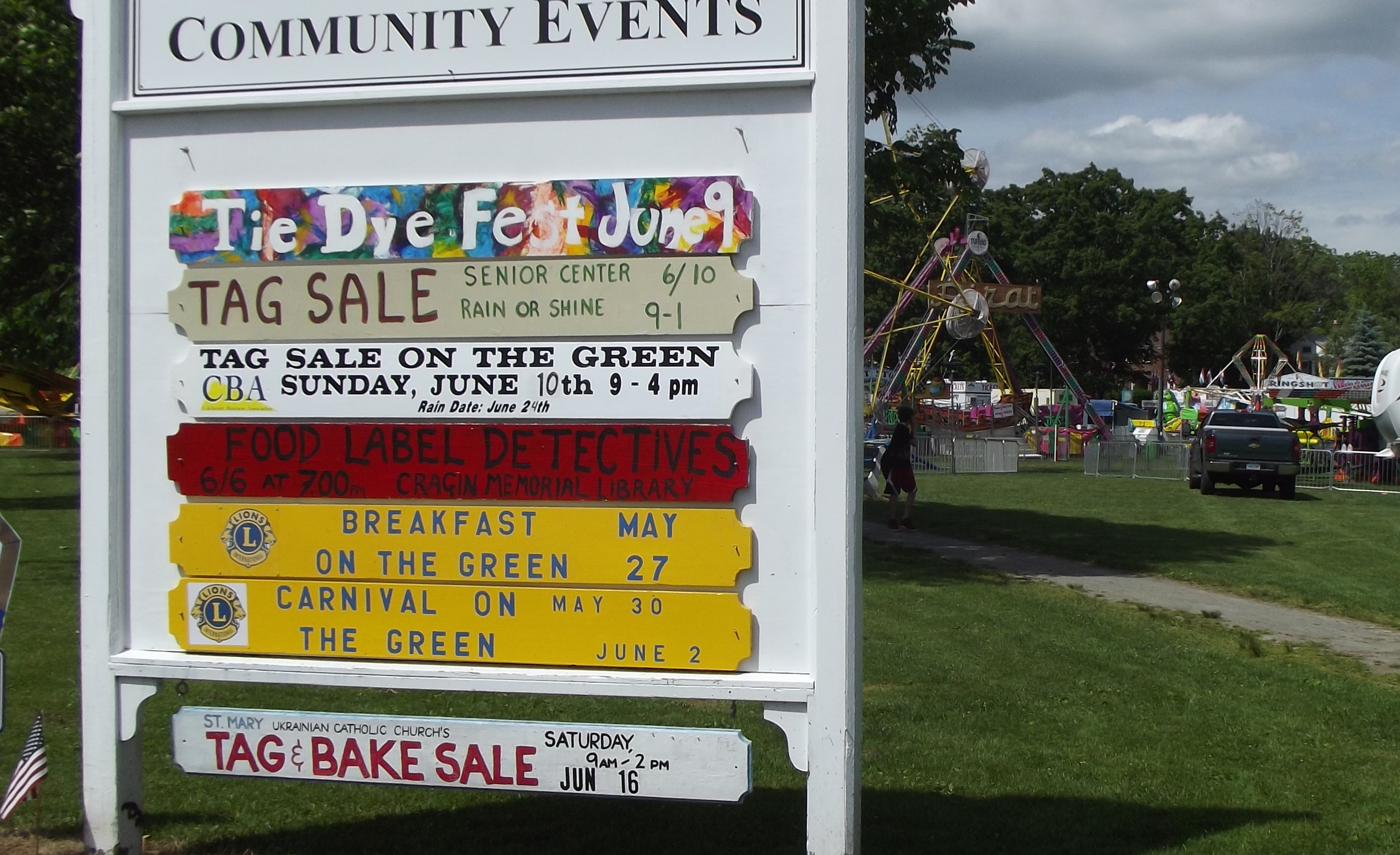
On a normal day, is this would be a quiet, uncluttered walked down lovely paths lined with benches and trees. Today was different. This is the week of the annual “Carnival on the Green,” kicking off town summer activities. The baseball field at the corner of the green was lined with port-a-potties for the occasion, and the green was very cluttered indeed! (Click photos to enlarge them!)


The carnival is only open at night, but all of the rides and booths sit on the green for the duration. So, our town bandstand was obscured by the quiet closed carnival skeleton as I took my walk. I felt a little like I was wandering around in a place I shouldn’t be! Eerie!


I finished my walk and went home, but my inner child felt a little like I’d missed the best part, so I went back tonight – dodging kids with cotton candy, parents with strollers, and teen couples with eyes only for each other.  And I experienced the living carnival – noise, lights, smells and all, right there in the middle of our little bustling town green. Fun!

Posted in Photo Challenges | Tagged , , , , , , , , , , | 49 Comments

What’s Going on with Social Security?? – Part 1

In the game of Financing Retirement, our sources of Money In aren’t as flexible as they were during our working years.. For example, two possible sources of income in the US have important rules governing when they are available, and for one, how much is available. These are IRA and 401k savings plans, and Social Security.

I’ll discuss my take on the savings plans in more detail in another financial post, but basically, they set aside an allowable amount of income each year “tax deferred,” reducing current taxable income. This means you don’t pay taxes on that income until you take it out of the account years later, when you are likely to be in a lower tax bracket. There are early withdrawal penalties for younger people, and minimum required withdrawals later.

The second benefit is Social Security. To keep things simple, in this discussion I won’t cover the disability aspects of this program. I want to concentrate for now on the basics of the retirement benefits, which are confusing enough! Setting aside (for the moment) the political questions of viability, how much do you really know about Social Security and the related Medicare benefits?

Here are a few questions every US citizen over 50 should be considering:

When can I take Social Security?   Many of us grew up thinking of 65 as Social Security’s magic retirement age.  That has changed.  For people born in 1938 and later, the age to receive full benefits gradually increases to 67. For most “baby boomers” (born 1943-1954) the age is 66. However, if you are willing to take a reduced benefit, you can begin as early as age 62.  For a boomer, that would mean a 25% reduction in monthly payments, but four additional years of benefits. See the tools available on the SS website to calculate your options and apply online.

When should I take Social Security?   That’s a very personal decision.  If, for example, you have been unemployed for some time or need cash flow, you may want to start early.  For every month you wait, however, your benefit increases, all the way until age 70. Personally, I’m hoping I can wait – that if I need additional income between now and 66+, I can work part-time to make up the difference.  That means I’ll have 25%+ more to work with each month later, when part-time work will be less possible. The Social Security Administration website has more detail to help with this decision.

How much can I expect from Social Security?  The Social Security Administration has made your account info available by mail for years. Now, they offer it online. The projections are based on what you and your employers paid in over the years, what you expect to continue earning, and your planned retirement age.  This is a good document to review regularly, if for no other reason than to assure the data matches your own records. We’ve reviewed ours regularly for the last fifteen years. You can also use the online estimator the SSA provides to see scenarios of payouts at different ages and retirement dates.

Is anything different for married couples?  Well, yes and no. Each person’s account is his or her own – there isn’t a “marriage penalty.”  However, if one of you dies, things can change.  The survivor will not continue to receive both checks every month. However, if the person with the larger benefit dies first, the survivor’s benefits can increase.  If the surviving spouse has taken Social security before his/her full retirement date, the amount of the spousal benefit will be reduced somewhat, but is still available. By the way, this spousal survivor benefit is also available to qualified divorced spouses.

Can anything else reduce my monthly Social Security benefits?  Besides taking benefits early, there are a few other things that limit or reduce payments.  If you work while taking retirement benefits, especially before your full retirement age, there will be adjustments. However, your benefits will be increased a little later.  Benefits also became taxable on a limited basis in the 1980’s – so when you are planning your Money In, you must also account for the tax Money Out.  Last, there is a maximum amount that can be earned by the formula, which changes whenever benefits are adjusted. This affects those who have been at the high income end.

When do I sign up for Medicare?   Generally, we become eligible for Medicare at 65, and you can apply online 3 months ahead.  It’s a good idea to learn about current options at least that far ahead, as it allows some time to evaluate them – and they need some review.  This should be done even if you are still working with benefits at 65. Information is available at the Social Security website.

Overall, it’s helpful to spend time surfing the Social Security site regularly, starting at age 50 or earlier, for updated information, planning tools, and links to other sites. You will also find help in financial publications, on brokerage sites, and at AARP.org. Of course, you can also call or visit your local Social Security office. Hopefully, these sources will help unravel the various aspects of Social Security to allow for the best possible decisions for this piece your retirement plan – and mine!

logo is the property of the U.S. Social Security Administration as seen on:

Posted in Finances, Financial Issues, Information, Retirement itself | Tagged , , , , , , , , , , , , , | 8 Comments

Travel Theme: Street Markets

Ailsa at Wheresmybackpack presented another photo challenge this week – street markets.  I couldn’t think of anywhere I’d photographed one, and then I remembered our trip to Beijing.

We started out shopping for souvenirs and gifts down the main shopping street, and noticed some side streets with outdoor booths.  We decided to wander down one, and found crowded allleys full of all kinds of goods made of brass, wood, and paper..

as well as food vendors selling roasted snacks – mystery meat and large insects on skewers!

Posted in Photo Challenges, Retirement itself, Travelogues | Tagged , , , , , , , | 44 Comments

War and Remembrance

In the United States of America, we celebrate Memorial Day on the last Monday in May.  This commemorative holiday has gone through several iterations – it was first called Decoration Day following the American Civil War, and the date has changed over time. The first observation of the day was May 3o, 1868. Flowers were placed on the graves of both Union and Confederate soldiers at Arlington National Cemetery to remember the sacrifices of all.

In my youth, we had a Memorial Day parade through our tiny town, where veterans paraded in uniform, along with color guards of boy scouts and girl scouts, and sometimes a local fife and drum corps, then other civil service and local organizations, including our local firefighters and 4-H club. We ended at a small war memorial across from our town hall, where the mayor and a representative of the local navy base spoke, Taps played, we all sang America the Beautiful and the national anthem, and the local pastor closed in prayer. Everyone stayed until the end.

In those days, the older veterans were from the “war to end all wars” – World War I. Both of my grandfathers had served, and my mother’s dad stayed active in his VFW post for many years. My father’s dad (right) served again in WWII. We purchased red paper poppies in remembrance of those lost and eulogized in the poem In Flanders Fields by John McCrae. We still buy those poppies from the VFW today.  World War II was still a stinging fresh memory for many adults when I was a child, as was the more recent Korean conflict.

My Dad in the field

When our own kids participated in our local parade years later, World War II veterans were the “old guys,”  and most of the WWI vets were gone.  At the end of our march, we corralled the kids in our group for the playing of Taps and the town reflective prayer, before allowing them to leave with their parents for popsicles and other fun. Those World War II veterans were part of, in the words of Tom Brokaw, “The Greatest Generation” – our parents’ generation.

My father-in-law

My Dad served in the army Signal Corps in Patton’s 3rd Army in Europe. He was at the liberation of the Bergen-Belsen concentration camp. My father-in-law served in the Pacific fleet. He was a gunnery officer on the Bolivar, one of many ships that transported troops to, and from, Iwo Jima.  My husband’s uncle survived Pearl Harbor and was never the same  Their haunted recollections of the war made us aware of the price paid not only by those who died, but also by those who served and lived.

By the time my grandchildren started marching in their parades, WWII vets were dying every day, but many survivors still participated. We were also starting to see aging veterans who had served in Vietnam. That’s a conflict that touched my generation deeply.  The draft was still active, and pulled our former high school classmates away in unthinkable numbers. So many didn’t come back.  Our involvement finally ended during my college years, but the US had come to think of overseas wars in a very different way. Some veterans were even treated quite poorly when they returned.  At the parades involving my grandchildren, parents left their roadside seats as soon as the parade ended to recover their little marchers – in every organization from scouts and Little League, to dance and karate schools. Very few stayed for Taps or the verbal remembrances.

It seems sometmes as though Memorial Day has become just a great reason for a three-day weekend and pre-Summer travel, rather than a time to gather as a community and remember those who made our lifestyles possible. Some people have suggested we go back to the May 3oth date, regardless of the day of the week, to refocus on the reason for this commemorative occasion. I know my friends who served in Vietnam, Iraq, and Afghanistan would appreciate our undivided attention to the work of our Armed Forces for an hour or so, if only once or twice each year.

Last Fall, when we were in Hawai’i, we visited the Punchbowl cemetery and Pearl Harbor Memorials. I cried throughout our visit to  the Arizona Memorial. It is a beautiful and poignant place. Small bits of oil seeping up from the carcass of the ship below create little rainbows on the surface of the water, and are known as the “tears of the Arizona.” The legend is that the tears will only stop when the last survivor has passed away.  And that probably is about when the oil will run out. They will be gone, but hopefully never forgotten.

So, the next time you see a vet outside your local grocery store selling paper poppies in support of his comrades-in-arms, please consider donating. If you have a child with you, maybe have the child do it. And when the vet thanks you, look him or her in the eye, and say, “No, thank YOU,” and remember for a moment all that you have because that person served. And if your eyes water a little, well, that’s not a bad thing.


Picture credits:        Poppies – © thoren90 – Fotolia.com,   Memorial Day Logo – © Richard Laschon – Fotolia.com

Posted in Family, Giving Back, Ruminations | Tagged , , , , , , , , , , , , , | 13 Comments

Thank You for Playing Our Game: Finding the Finish Line

Welcome to my exciting new board game, Financing Retirement!  This game is for one or two players, and includes dice and two stacks of cards to draw from – Money In, and Money Out.  The goal is to have a positive balance in your bank account when you reach the finish line – your retirement date!

Assuming you can choose your own timing for retirement, how will you know when you have enough to really live on?  My beloved and I are working through this now. We’re playing the two-person version of the game.

He actually retired from a high-stress upper management career a number of years ago. We could afford it at the time because I was working and paying for benefits, and we agreed to cut back on meals out, some of our travel, and other optional spending.  Because of the toll his work was taking on his health and well-being, frankly I pushed him into it, and we both still believe it was the right thing at the time – but it didn’t stick. To stay busy and pay for the vacations we wanted, he decided to work part-time until I retired. The new job crept up to full-time.

Then the situation reversed, and my job started taking a serious toll on me. I was able to retire, because he is still working.  Now one of my primary goals is to figure out how, and when, we can both be (and stay) retired at the same time.

Really, this is a two-part puzzle, because (as with any balance sheet) there are two sides on the ledger, and they have to be in balance. We all know the drill: Assets and Liabilities. Income and Expenses. Deposits and Withdrawals.

Potential retirement assets are savings, a home, pensions or other retirement plans (including any IRA and/or 401K accounts), Savings Bonds, stocks, collectibles, part-time work, and (in the US) Social Security. These would be the Money In cards in our game.

Likely liabilities are a home and associated costs, transportation costs (car or other), food, clothing, entertainment, travel, hobbies, insurance, gifts, taxes, debts, and (particularly in the US) medical expenses. These, of course, are the Money Out cards. They may change as the game goes on.

Financial planners and brokerage houses have all kinds of tools and models to help with planning.  Historically, they have commonly suggested you will need 80% of your annual pre-retirement income for each retirement year, or that you apply a 4% withdrawal rule (which amounts to a 25- or 30-year plan, where you live on 4% of your available assets annually) A quick wake-up call can be found on US News & World Report’s Money/Retirement Page – a calculator of how long your current assets will last.

These are obviously all meant as starting points rather than absolute rules, as every case is different. So, I plan to do a number of posts explaining my method for figuring out when we can both be retired at the same time – and pay for it.

The first step is to rough out the two sides of the ledger. If you’ve never used Excel or another spreadsheet program, this might be the time to start – otherwise, pull out some lined paper and a calculator! What assets do you have now, or can you reasonably expect to have by your target date? For Social Security, see the SS website estimator, if you need help.

Then comes the tough part – estimate your expenses. You can start by tracking your current monthly and annual expenditures. The biggest future unknown in the US is likely to be medical expenses. Medicare, Medicare supplements, deductibles, co-pays, dental and vision care, prescription drugs… all these can add up! To make it a little dicier, you have to guess at your future health needs and what congress will do with Medicare funding. (You might want to invest in some Tarot cards or a crystal ball for this.) The point is, you have to start somewhere. Forewarned is forearmed, and the worst thing you can do is nothing.

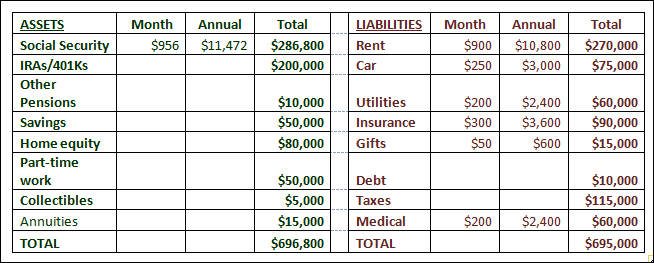
Take your time and get everything you can think of into your ledger. Each item should have 3 columns – monthly, annually, and total (initially, use the number of years it will take you to get to 90, depending on how old, or young you plan to be when you retire).  Here’s a very basic sample of what a balance sheet might look like:

Alrighty, then!  You’ve taken the first step in setting up the board!  Next:  Social Security and Other Assets

Photo credits:  board game: © linno – Fotolia.com, tarot: © Darla Hallmark – Fotolia.com, puzzle: © vege – Fotolia.com.

Posted in Finances, Financial Issues, Information, Retirement itself | Tagged , , , , , , , , , , , , , , | 16 Comments